
Peptide Sciences has officially shut down. The company’s public statement says it voluntarily decided to discontinue operations and stop selling its research products. That part is confirmed.
What is not confirmed is the exact internal reason why.
Since then, the peptide space has filled in the blanks with a mix of hot takes, speculation, and marketing spin. Some people are framing this as proof that peptides are dead. Others are acting like it means nothing at all.
Neither take is especially helpful.
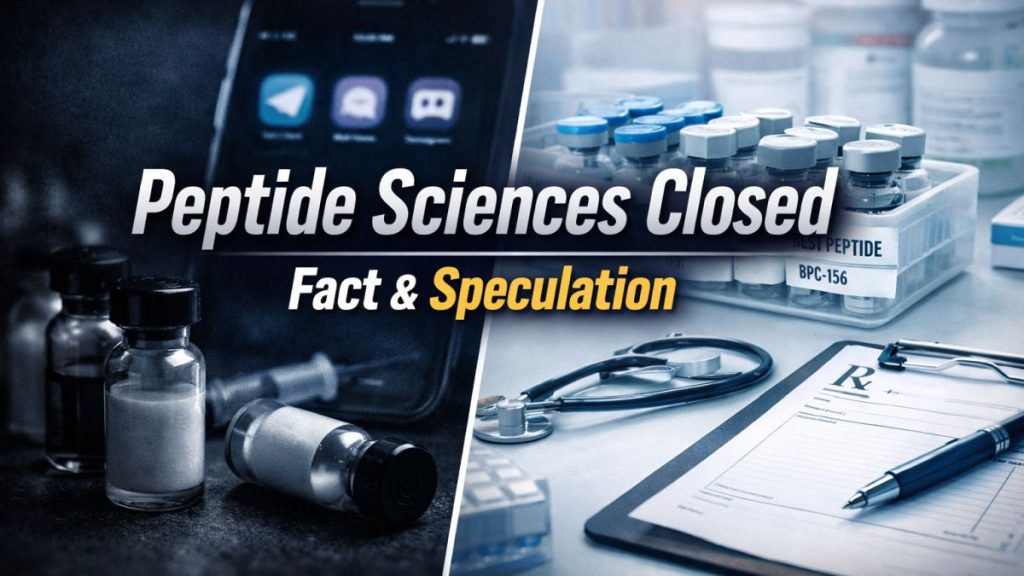
Fact vs Fiction
Here is what we can say with reasonable confidence.
First, this does not mean peptides are dead.
It also does not prove Peptide Sciences was raided, forced out, or shut down by a specific enforcement action. At least based on what is public, the company itself has not said that.
Second, this closure does fit a broader pattern.
FDA has been increasing pressure on unapproved peptide and GLP-1 sellers, and it has made clear that labels and disclaimers do not carry much weight when the surrounding facts suggest human-use intent. FDA has also recently said it intends to take action against non-FDA-approved GLP-1 active pharmaceutical ingredients being used in mass-marketed compounded drugs.
So no, this is not proof that “everything is over.” But it is a signal that the old public-facing gray-market model is getting squeezed.
Does Peptides Sciences Closure Help The Industry?
I do not think this automatically helps the legitimate industry in the short term.
If consumers lose easy access to familiar gray-market sites, many will not immediately move toward licensed medical pathways. A lot of them will look for the next-cheapest, easiest option first, which likely means darker channels like private groups, Telegram, Discord, WhatsApp, and informal resellers. That could actually make the medium-term environment messier before it gets cleaner.
The same basic economic pressure applies to some practitioners too. Price and assortment still matter. The difference is that experienced providers usually do far more diligence than the average end consumer.
That is why the real “saving grace” may not be the collapse of gray-market retail by itself.
The saving grace is whether legitimate channels remain viable and cost effective.
FDA’s compounding framework still recognizes distinct 503A and 503B pathways. Section 503A is tied to valid patient-specific prescriptions, while 503B applies to registered outsourcing facilities.
If those lanes remain workable, and if access through legitimate providers improves, that is the clearest path for more demand to migrate away from the gray and black markets over time.
At the same time, not every peptide has a clean path through those systems either. FDA continues to maintain Category 2 as a bucket for nominated bulk substances that “may” present significant safety risks in the compounding context.
Many of the peptides on the Category 2 list have high consumer demand, and since they are not readily available from 503A/B pharmacies, people wind up getting them through the grey (RUO/PUO/CUO) market.
RFK Jr. recently said on Joe Rogan that 19 peptides were illegally moved to Category 2 between 2021–2025, and that was the catalyst that grew the grey/black peptide market so quickly.
He additionally stated that he was “very anxious” to move about 14 of those Category 2 peptides back to Category 1 allowing them to become more accessible through legal channels. He suggested FDA action could come within weeks.
If that happens, it might pave the way for more legitimate accessibility (through 503A/B pharmacies), and may result in less grey/black market peptide purchasing.
So the long-term outcome will depend not just on RUO crackdowns, but on whether or not legitimate channels can offer enough access and value to pull people toward the safer lane.
Peptide Sciences Closure: My Basic View
Peptide Sciences shutting down does not prove peptides are dead. It does suggest the gray-market retail model is under more pressure than before.
In the short term, that may push some buyers deeper underground.
In the long term, it likely strengthens the case for legitimate sourcing – but only if legitimate pathways remain workable and competitive.
And one last point: I think Peptide Sciences probably made a smart move. Whether this was purely proactive, partly risk-based, or both, it is hard to ignore the possibility that they simply decided the upside was no longer worth the exposure.